The Challenge
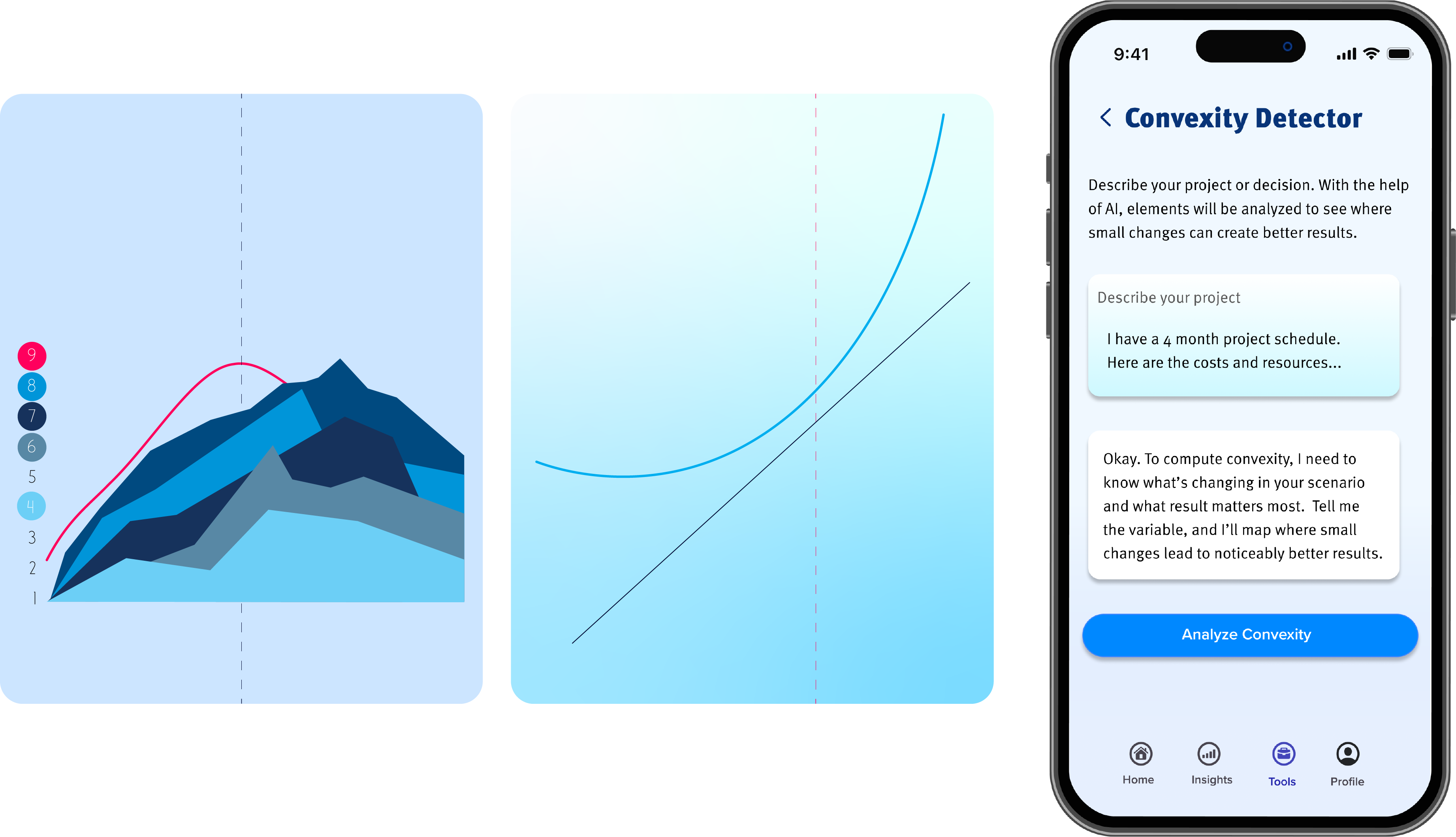
People make hundreds of decisions across work and personal projects like budget choices, schedules, prioritization, yet most rely on intuition not structured reasoning. Traditional tools are rigid: spreadsheets demand formulas, dashboards require expertise, and risk models are inaccessible to everyday users. The challenge was to design a decision intelligence system that makes complex quantitative concepts like Bayesian reasoning, variance, convexity feel intuitive. Instead of forcing users to input structured data, Polaris Arc turns plain-language prompts into AI-driven insights that reveal hidden opportunities, uncover fragility, and highlight where small changes create big impact.
My Role
I led the product vision, UX architecture and interaction model for an AI-first decision tool. The project turned mathematical models into approachable, conversational intelligence, making decision modeling simple by describing your situation in plain language. I shaped how the AI interprets ambiguity, prompts for clarifications, and translates probabilistic outcomes into strategic, actionable insight.
Design Approach
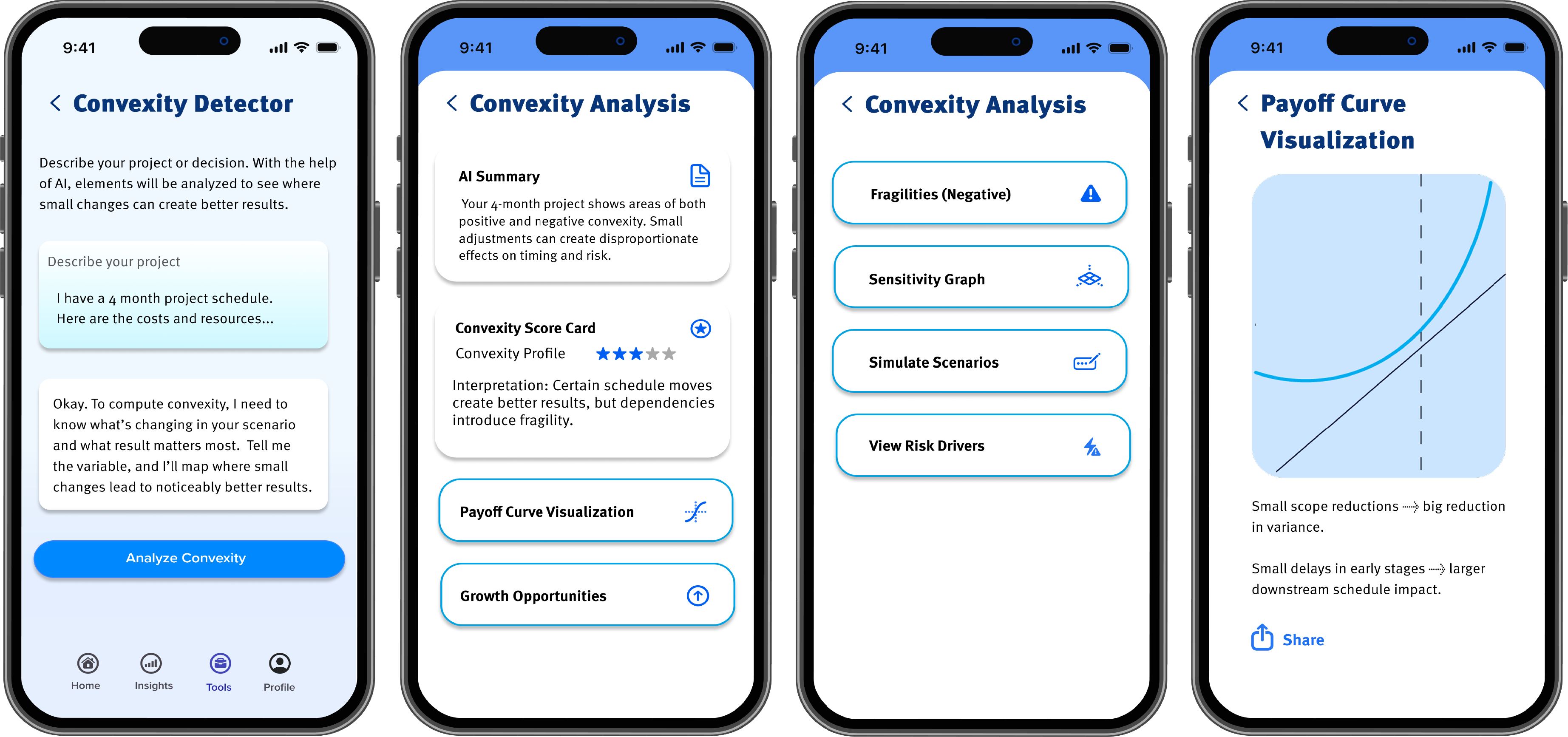
- Natural Language Inputs for Complex Models: Replaced traditional forms with a single prompt box. Users describe their project in their own words.
- System Inference: The system infers timelines, sensitivity, uncertainty and dependencies, then requests minimum clarifications.
- Conversational Decision Reasoning: Designed an AI reasoning layer that translates complex math into narrative insight.
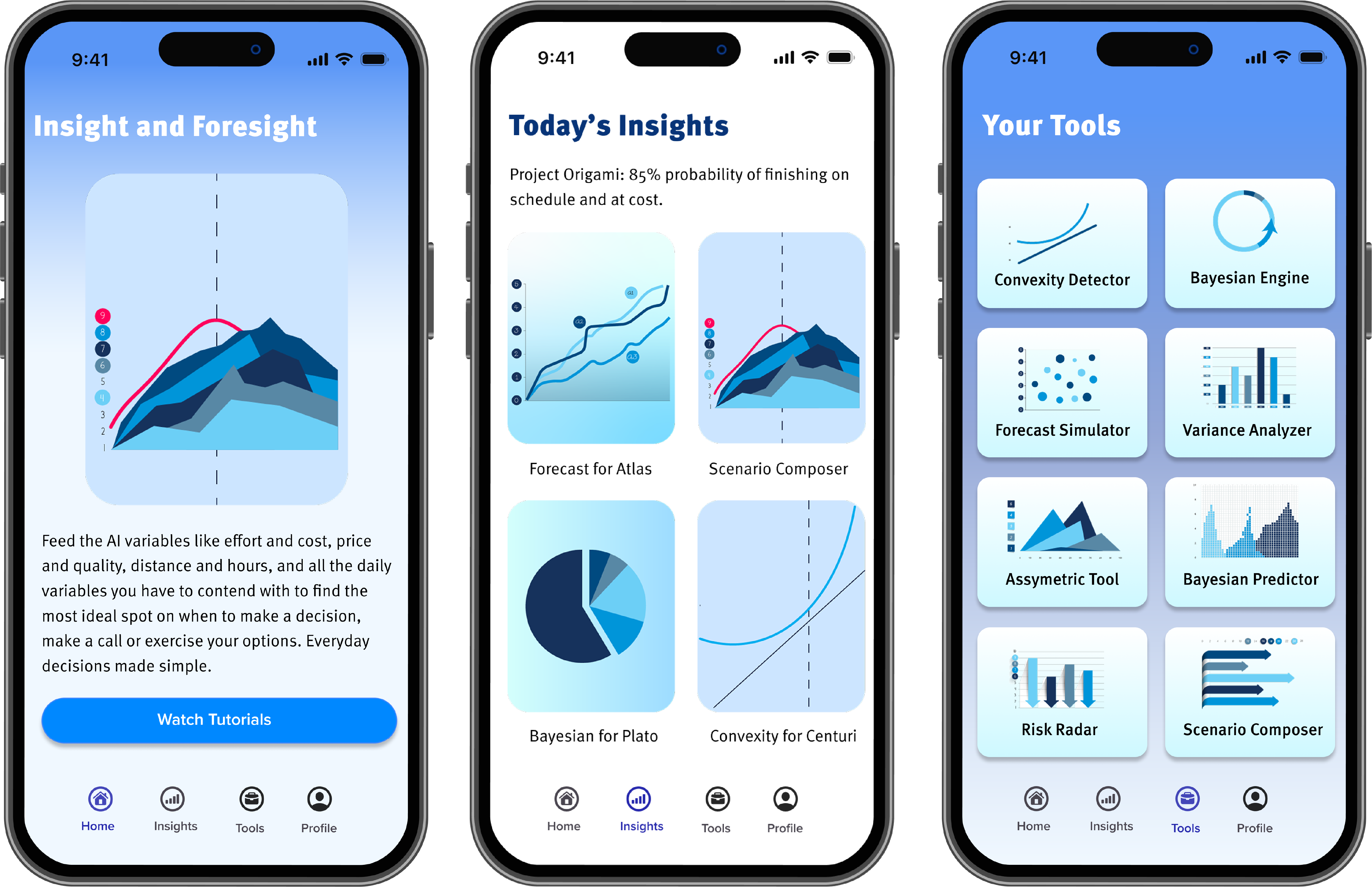
- Convexity and Risk Visualization: Developed lightweight, mobile-first visualizations that reveal hidden trends without overwhelming users.
- Human-Centered Guidance Through Uncertainty: The interface have reporting capabilities that make content easy to understand, not another spreadsheet.
Impact
- Making Complex Simple: Mathematical models made available with natural language prompts.
- Elevated Decision Confidence: Users reported feeling more confident in their decisions, product helped with reducing ambiguity in complex decision scenarios.
- Reduced Cognitive Load in High Uncertainty Planning: Using natural language eased the complexity associated with timelines, resources and risk evaluation which can lead to faster planning cycles and fewer iterations.
Key Takeaway
This project showcases how decision intelligence can be redesigned for simplicity, where abstract mathematical concepts can be used to offer practical, everyday insights and foresights. Using natural language as prompt, the AI decisioning tool feels collaborative rather than prescriptive.